
Hiring basement builders in London usually comes down to three quotes, a few photos of finished rooms and a gut feel about who you’d rather have in your house. That’s fair enough. But finished photos don’t show you the temporary works, the party wall process or the concrete behind the plasterboard, and those are what decide whether a basement goes well.
We’ve been building basements and substructures across London and Surrey since 2013, and our directors are on site on every job. These are the ten questions we’d want answered if we were hiring basement builders in London ourselves. Ask them of every firm on your shortlist, us included.
Before you ask: get your paperwork together
You’ll get far more useful answers if every builder is pricing the same information. Before you start meetings, it helps to have planning consent, the engineer’s structural drawings, a site investigation and, ideally, a party wall surveyor appointed.
With those in hand, basement builders in London can price the real job rather than guess at it, and you can compare their answers like for like. Without them, you’re mostly comparing assumptions.
1.Who will actually be on site?
Some basement builders in London win the work and then subcontract the excavation, formwork and steel fixing to whoever’s free. That isn’t automatically wrong, but you should know about it.
Ask who employs the people digging, shuttering and fixing, and who’s in charge day to day. A firm that self-delivers the main trades has fewer handovers and one point of responsibility when something needs sorting.
2.Who designs the temporary works, and who checks them?
The props, needles and staged excavation that hold your house up during the dig are temporary works, and they matter just as much as the permanent structure. In the UK they’re normally managed under BS 5975, the code of practice for temporary works.
A good answer names the temporary works designer, explains how the design is checked and tells you who on site has the authority to stop work if something isn’t right.
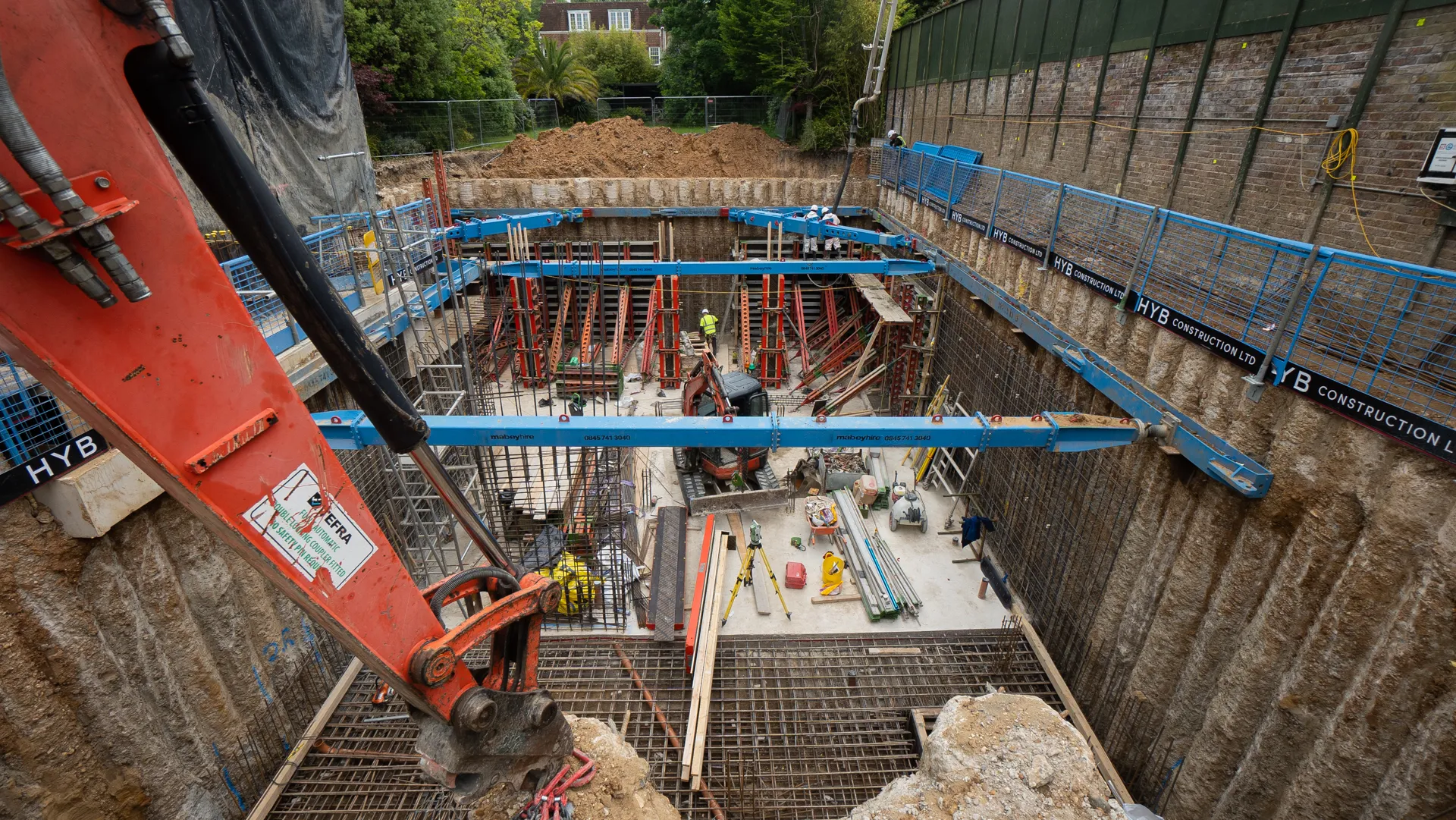
3.How will the underpinning be sequenced?
Underpinning is normally done in a hit-and-miss sequence: short sections cast in a set order, so the wall above is never left unsupported over a long length. Your engineer sets the sequence and the builder has to follow it to the letter.
Ask them to talk you through it. Capable basement builders in London will explain it in plain English. If they can’t, treat that as a warning sign. It’s also worth asking what they do when they find something unexpected under a wall, such as an old drain or a stepped footing, because on London terraces that happens more often than you’d think.
4.How do you handle party walls and monitoring?
Most London basements involve digging close to a neighbour’s foundations, which brings in the Party Wall etc. Act 1996. Get this wrong and the job can stall before it starts. Notice generally has to be served at least a month before that work starts, and the government’s party wall guidance explains the process.
Ask how the builder works with party wall surveyors, whether they’ve built to awards with movement monitoring before, and what they do if a monitoring point moves more than expected.
5.What waterproofing is designed, and who’s responsible for it?
BS 8102:2022 is the British Standard for protecting below-ground structures from water. It covers barrier systems, structurally integral concrete and drained cavity systems, and most habitable basements use more than one.
Find out:
- Which types of protection have been designed for your basement.
- Who’s building each part, and who’s responsible if there’s a leak.
- How construction joints and waterbars in the concrete will be handled.
The concrete box is the first line of defence. A membrane can’t make up for poorly built concrete, so don’t let the conversation stop at the tanking.
6.What’s in the price, and what’s left out?
Basement quotes are hard to compare because the risky items are often excluded or covered by a provisional sum. Look closely at groundwater, unexpected ground conditions, spoil removal, temporary works design and any drainage diversions.
Ask each of the basement builders in London you’re comparing to set out their scope in writing against the same drawings. If one price is much lower than the rest, it’s usually because something’s missing.
7.How will spoil come out and materials go in?
Access is one of the biggest factors on a London basement. Conveyors, muck-away lorries, concrete deliveries and parking suspensions all need planning, and many boroughs ask for a construction traffic management plan.
Ask how the builder intends to run the site day to day, and how they’ll keep the street and the neighbours on side. The better basement builders in London will have a logistics plan ready before you ask.
8.What accreditations and insurances do you hold?
Accreditations are an independent check on a contractor’s health, safety and management systems. Ask for current certificates and proof of insurance, not just a row of logos on a website. Any of the basement builders in London on your shortlist should be able to send these without fuss.
We hold Achilles, Considerate Constructors Scheme, RISQS and SafeContractor accreditation. The Planning Portal’s basement safety guidance is also worth reading before you sign anything.
9.Can I see a similar project and speak to someone involved?
Photos help, but a conversation with an architect, engineer or client who’s worked with the builder tells you far more. Ask for a project of similar depth and access to yours. If they can show you photos from the excavation and the pours, rather than just the finished room, even better, as that’s where the real work happens.
Our Holland Park project, a deep basement and pool under a Kensington home, shows the kind of work we take on.
10.Who’s my point of contact, and how often will they be on site?
Plenty of firms send a director to the first meeting and a different face to site. You want one person who knows the job inside out and can make decisions on site, not from an office across town. Ask how often a director or senior manager will be there, and who you ring when something comes up.
On our jobs, the directors are hands-on and on site throughout. We think that’s the right way to run a basement.
Choosing basement builders in London: what good answers sound like
None of these questions needs a technical background. What you’re listening for is whether the answers are clear, specific and consistent from one meeting to the next. Vague promises about quality are easy; a named temporary works designer and a written scope aren’t.
The best basement builders in London will be glad you asked, because it shows you’re taking the job as seriously as they are.
If planning’s in place and you’d like to talk through your scheme, send us your drawings and your engineer’s details. You can read more about how we work as basement contractors in London, or get in touch with one of our directors.
Request a quote